
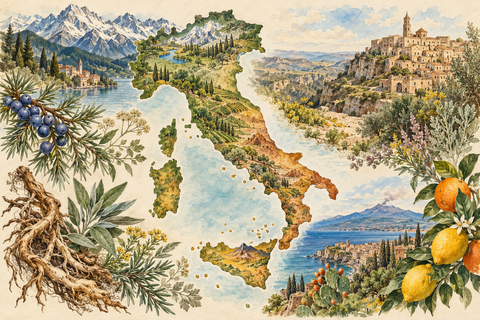
The stories behind Braulio, Lucano, and Averna—from the Alps to Sicily.
Italian amaro has no single flavor profile. Some examples emphasize bitter roots and mountain herbs; others bring citrus, floral aromas, or a richer balance of sweetness and bitterness.
Geography provides a useful starting point for understanding those differences. But a region doesn’t dictate a recipe: individual producers have their own methods, ingredient combinations, and histories. Three examples—from Lombardy, Basilicata, and Sicily—show how varied the category can be.
Northern Italy · LombardyBraulio and the herbal traditions of the Alps
Bormio is a mountain town in Lombardy, in northern Italy near the Stelvio area. It is also the birthplace of Braulio.
The producer traces its origins to the Peloni family’s pharmacy and its study of aromatic plants. Francesco Peloni developed the amaro in 1875, building on botanical knowledge passed down by his father, Giuseppe. That connection to pharmacy and herbal experimentation helps explain the language surrounding many historic Italian amari. Braulio’s history ↗
Braulio identifies four ingredients publicly: gentian, juniper, wormwood, and yarrow. Its published tasting description emphasizes roots, wood, aromatic herbs, and a lingering bitterness. The full recipe remains undisclosed. Braulio’s botanical information ↗
The word balsamic, often used to describe this style, refers to resinous, cooling, or aromatic herbal impressions—not necessarily the flavor of balsamic vinegar.
Explore this amaro: Braulio Amaro Alpino 1L
Southern Italy · BasilicataLucano’s roots in Pisticci
Basilicata lies in southern Italy, between Campania, Puglia, and Calabria. Pisticci, in the province of Matera, is where Pasquale Vena created Amaro Lucano in 1894.
Vena’s background was in pastry making, alongside an interest in herbs. According to the family’s account, he developed the recipe in the back of his biscuit-making business. The producer describes the original mixture through its herbal character and citrus and floral notes. Lucano’s history ↗
Lucano’s production process also illustrates why an amaro cannot be understood simply by counting its botanicals. Its published method includes infusion, pressing, blending, a maturation period for the extract, and the later addition of ingredients including sugar and caramel. Extraction and blending shape the finished character as much as the ingredient list does. Lucano’s production process ↗
Explore this amaro: Amaro Lucano 750mL
Island of Sicily · Central SicilyAverna and Caltanissetta’s family history
Averna’s story begins in Caltanissetta, in central Sicily.
According to the producer’s historical account, the recipe originated with monks at the Abbey of the Holy Spirit. In 1868, a monk named Frà Girolamo gave it to Salvatore Averna, who initially prepared the amaro for guests at the family’s Villa Xiboli residence. Later generations expanded production and introduced it to a wider audience. Averna’s history ↗
Averna describes its identity through Mediterranean herbs and a bittersweet profile. Its history offers a different perspective from Braulio’s Alpine pharmacy tradition or Lucano’s pastry-shop beginnings: a recipe moving from a religious community into family hospitality and eventually commercial production.
Explore this amaro: Averna Amaro 1L
What a region can—and cannot—tell you
Regional origins explain where a recipe developed and the traditions surrounding it. They do not establish that every botanical grows locally, that all amari from the same region taste alike, or that a historic recipe has remained completely unchanged.
When reading about an amaro, separate three things: documented ingredients, the producer’s tasting descriptions, and the historical story. An aroma resembling orange, mint, or spice does not, by itself, confirm that ingredient is in a secret recipe.
Illustration: AI-generated artwork inspired by Italian landscapes and botanicals; not a botanical identification chart or precise geographic map.
Comments (0)
There are no comments for this article. Be the first one to leave a message!