
A lot of bottles in this business like to play dress up.
Old script on the label, some made-up “good story”, a flavor optimized for mass appeal and suddenly everybody is talking about the latest fad crap juice in a container. One cheap gimmick after another its no wonder this industry finds itself in the condition it’s in.
Chartreuse exists in a different plane.
Chartreuse is not “inspired by monks.” It is not “based on an old recipe.” It is not some brand idea of what old Europe is supposed to look like. It is still made by the Carthusian monks, the Catholic order founded by Saint Bruno in 1084, men whose life is built around silence, solitude, prayer, and work. The whole point of their life is contemplation. They get up in the middle of the night for the long office of Matins and Lauds, they live largely in silence, and manual labor is part of the structure of the vocation itself.
That matters, especially in Lent, because Lent is supposed to be about restraint, discipline, and taking your appetites down a few notches. Most brands are built on the complete opposite. More volume, more distribution, more line extensions, more noise, more nonsense. Chartreuse comes out of a religious order whose entire life is basically a rejection of that kind of expansionist thinking. So if you want a bottle that actually makes sense in the season of Lent, this is one of the few, and the only liquor imported into the US.
The story starts in 1605, when François Hannibal d’Estrées handed a mysterious manuscript to the Carthusian monks in Paris. It took more than 150 years for the monks to fully decipher it and establish the formula for the Élixir Végétal (original Chartreuse) in 1764. Green Chartreuse and Yellow Chartreuse followed in 1840. This is not George Clooney and his two amigos riding motorcycles; The monks spent generations getting here.
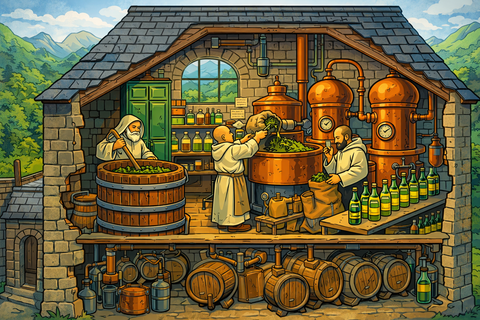
The recipe is built on 130 plants, flowers, bark, roots, and spices, and the production is still tied directly to the monks’ work. On the official Chartreuse material, the grinds are made by the monks in the plant room at the Grande Chartreuse monastery before distillation, maceration, and long aging in oak vats, which btw is the largest liquor cellar in the world.
Green and Yellow are what most people have heard as the two main types - Green Chartreuse is 55% ABV. It is sharper, more forceful, more resinous, more mint, more alpine, and more heat of course. Yellow Chartreuse is 43% ABV, softer, rounder, spicier, and a little more generous with viscosity, but the flavors shine brighter in the absence of higher proof. Same monastic DNA, same 130-botanical universe, different expression. Green is the robust awakening. Yellow is easy on the palate sipper.
And this is where the monks reaffirm their commitment to their faith first. In 2021, the Carthusian monks decided not to increase production volume for Chartreuse. That decision became widely felt in 2023 when allocation tightened. The stated reason was not supply chain theater or fake scarcity. It was to protect monastic life and devote time to solitude and prayer. In other words, they looked at rising global demand and said, more or less, no. The modern liquor industry hears “demand spike” and yearns for production and distribution increase. The monks heard it and went back to prayer.
That decision is exactly why Chartreuse still feels important. Most brands are tuned by the market until they are smooth, broad, harmless, boring and eventually made with antifreeze ingredients. Chartreuse still tastes like something made by people whose first loyalty is to God and not growth. The company itself says the mission is to sustain the Carthusian order and to take account not just of economics but also social, local, and environmental considerations. Some french farmers feed their cattle Chartreuse for digestive benefits. That is not spirits industry language, and you should appreciate the difference.
As far as the U.S. market goes, Chartreuse appears to stand alone in a meaningful way. Frederick Wildman is the sole U.S. importer, and liquor industry writers describe it as uniquely tied to an active monastic order. There are Trappist beers and monastery wines and cheesecakes, honeys and jams, yes. There are even new monastery-adjacent distilling efforts beginning in the U.S., and we would love to get to taste that too, but it is not the same as a centuries-old spirit still made and controlled by the same order of monks. That is why Chartreuse gets the attention it gets. It is the real deal.
So the right way to talk about Chartreuse is not as some hard-to-get herbal after dinner drink or cocktail ingredient people argue about online. It is one of the last serious bottles in the world that still carries the weight of the people who make it. Not a mascot. Not a monk shaped bottle. Not the name of an order of monks slapped on a label. These are actual monks, actual continuity, actual discipline. In an industry full of fakes, it should mean something to you.
Where to Buy Chartreuse in NYC (Bronx & Westchester)
If you’ve been searching for Chartreuse in New York—whether it’s Green Chartreuse, Yellow Chartreuse, or just “Chartreuse near me NYC”—you already know it’s not something that sits around on shelves for long.
Most places in Manhattan, the Bronx, and Westchester County get limited allocations, and when it lands, it disappears just as fast. That’s what happens when the monks decide they’re not making more.
At Arthur Cantina Wine & Liquor, we actually keep a strong supply when it’s available. We’re located right in Bronx Little Italy at 2380 Arthur Avenue, Bronx, NY 10458, and we specialize in hard-to-find bottles like Chartreuse, rare herbal liqueurs, and monk-made spirits that most stores either can’t get or don’t understand.
So instead of chasing it across NYC or hoping your local shop magically restocks, just come straight to the source.
Stop by Arthur Cantina Wine & Liquor on Arthur Avenue in the Bronx and check out our current selection of Green Chartreuse and Yellow Chartreuse while it’s still on the shelf.
Because once it’s gone, it’s not coming back quickly—and the monks aren’t rushing production for anyone.

Comments (0)
There are no comments for this article. Be the first one to leave a message!